
The Power of Smartphone Camera - I: Smartphone Microscopy
Can we use our smartphone camera as a potential camera sensor for a microscope?
11/3/20253 min read
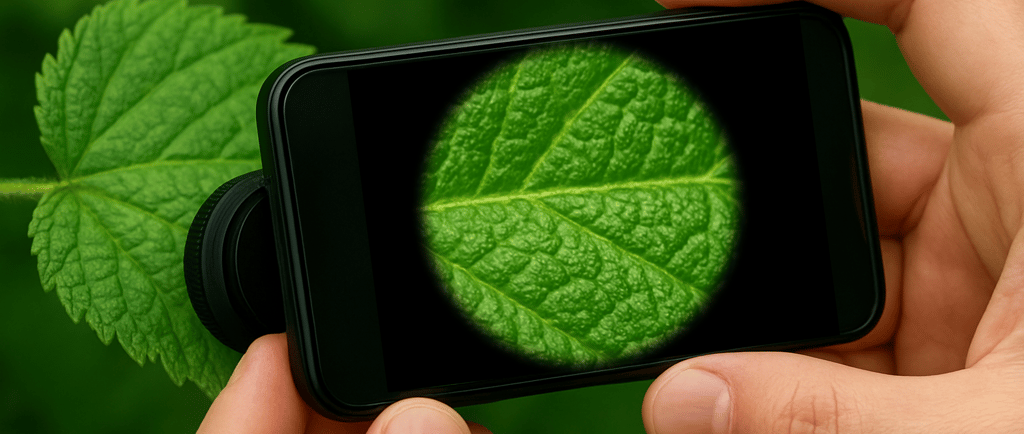

The camera present in everybody’s handset is getting more and more powerful day by day. Other than amateur photography, selfies for instagram posts, and making reels, it is already in many other regular uses. It is being used for scanning QR-codes, scanning texts, and number of uses through different apps. But, can it be used as an image sensor for professional purposes like microscopy for biomedical applications or material quality checking?
A number of scientific research groups have already worked on this. And the result is quite positive and beneficial!
What do you need for a brightfield or fluorescence microscope? You need an illuminating light source. You need an objective lens (or lens system - combination of multiple lenses). You need an eyepiece or the ocular lens which makes the magnified image of the sample in our eye. Nowadays we want to see the magnified image digitally. So we need a digital image sensor - CCD or CMOS - accompanied by the ocular lens.
Now think of using the camera of your handset as the image sensor for the microscope. But this does not do any practical help to replace a conventional camera sensor by our smartphone camera in the laboratory microscope! It will be useful if we can make the whole microscope as handy and portable as our ‘mobile’ phone. The assembled size and cost of a lab-grade optical setup of the objective and illumination setup will not leave it ‘handy’ anymore.
Researchers are trying to change this scenario. They are designing small setups of pocket-sized attachments to the phone that will consist of the illumination optics, and a smaller and simpler version of the objective lens system. And may be a filter for fluorescence setup.
Well, the result will obviously not be as good as the high-end laboratory microscopes, but also not very bad!
This approach actually started quite long ago - even when the phones were not enough ‘smart’. It means their cameras were also not as strong as today's.
In 2009, Breslauer et al. presented a smartphone-based setup which had a measured resolution of 1.2 µm and a Field of View of 180 µm diameter.
N. A. Switz et al. presented a setup in 2014 with a quite larger Field of View of 10 mm2.
There are lensfree approaches using ambient illumination and image-enhancement using postprocessing algorithms on multiple images.
There have been multiple studies with multiple different approaches from Ozcan’s group at UCLA. They came up with a lensfree microscope with a holography based approach. In another report, they presented a device able to image and size single DNA molecules on a mobile phone.
As examples of smartphone-based fluorescence microscopy, there is a reported prototype which offers a 10 µm resolution over a 81 mm2 field of view. A report from Wei et al. showed imaging of 100 nm fluorescent nanoparticles and viruses through smartphone. A few years later, the same research group reported 10 times enhanced fluorescence intensity with a thin metal-film based surface-enhanced fluorescence to image particles of 50 nm diameter as well as single quantum dots.
A very recent study by Loretan et al. reported super resolution imaging and single molecule detection of DNA origami models and RNA detection through low-cost portable smartphone-microscope attachment.
All those reported studies show quite promising results that can be practically used for field-research, Point-of-Care diagnostics, medical survey and telemedicine, education purposes in low-resource and low-infrastructure places.
The problem with image quality - caused by aberration or improper illumination - because of simpler optical setups, can be overcome with computational corrections. - That also when the image processing algorithms are becoming more and more efficient with the help of machine learning and deep learning!
Commercial products like Carson Microflip or Nurugo Micro-Pro, costing around 25 € or 60 €, will not give you the microscopic image of a 5000 € microscope from ZEISS or Leica. But they can surely serve as a basic smartphone-microscope for hobbies, basic field diagnostics, or education purposes.
Contact
contact@rgbian.com
© 2025. All rights reserved.